Tuesday, May 14, 2019

Romans, Romans everywhere! Israel, Day 4

Scythopolis


We left for Tiberium that morning, the intact Roman city Scythopolis that had been buried and recently unearthed.


More than Caesarea, this was a a working city with shops, temples, streets, courtyards, public toilets, theater, and all protected by the earth until it was recently discovered and unearthed a short time ago.


I took Latin in a vague attempt at possibly studying medicine (that didn't work out), so this was a weird trip down memory lane as I tried my hand at reading graffiti or attempting to figure out what a building was before the guide explained.


That was overwhelmed at first by trying to figure out how an entire city was buried by 30 feet of dirt. That defies any attempt as you look up at the ground above and realize that the street you are standing on was once covered by THAT much ground. How does that even happen naturally? And I really should rake the leaves in my yard.


We then boarded the bus and continued through the desert to Jerusalem. That was another striking thing about Israel, the incredible variety of biomes within a country so small.

And Cats...


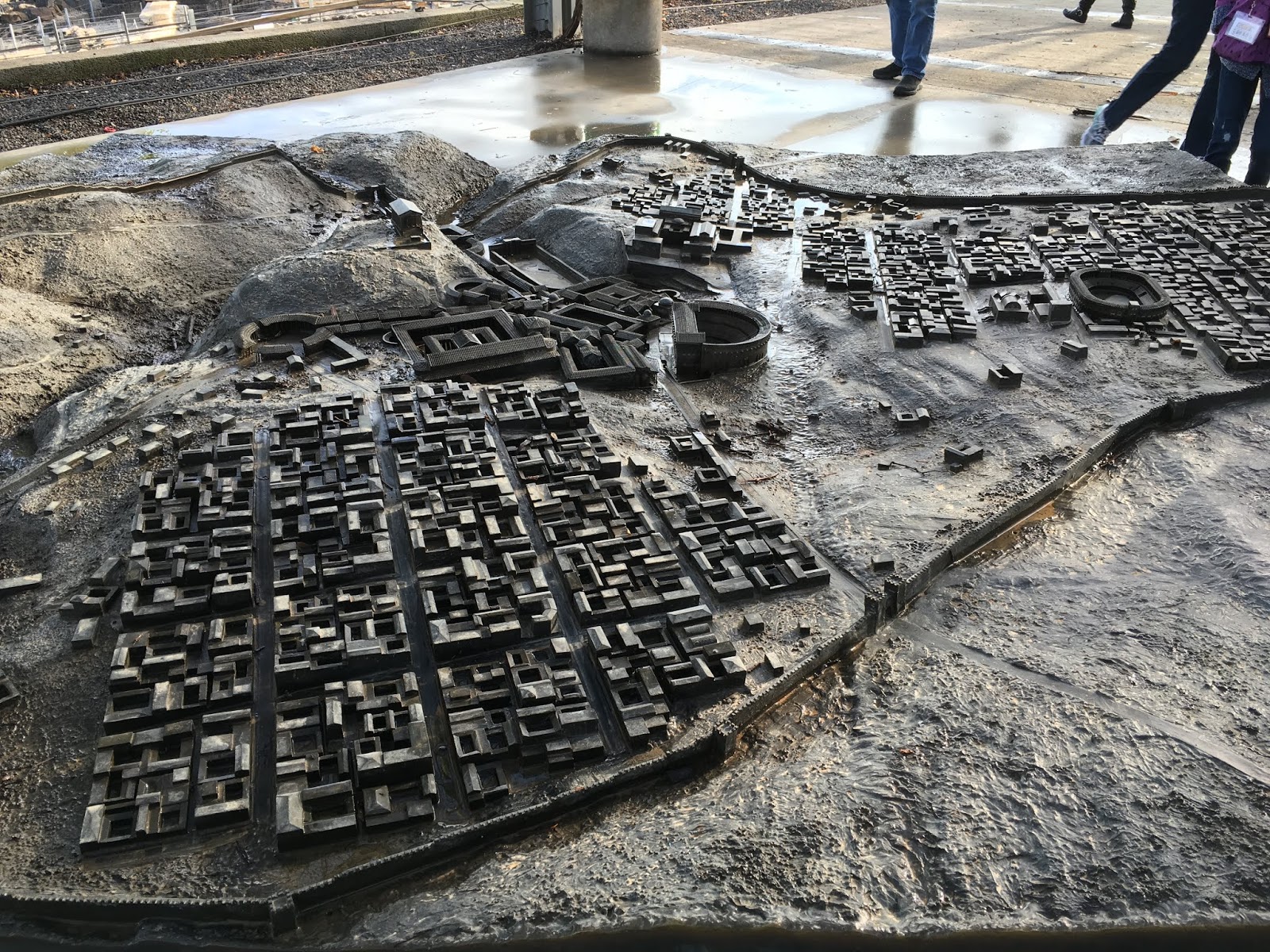
We finally arrived in the city, got to our hotel, and then headed right back out again to the Israel Museum and a scale model of the city from 2,000 years ago.


 Sitting on a balcony overlooking the area it is easy to locate key features from the model, and the outdoor display is labeled in a way that provides plenty of information, but spread out for the tourist crowds.

We were also able to see the museum housing the Dead Sea Scrolls, as well as the Holocaust Museum. I won't attempt to describe the latter, or try to reduce to words the emotional scale or toll it takes on someone, but will insist that if you go, this is a must experience.
 

 Finally, we boarded the bus, and went out into the city that evening for dinner and drinks. Machene Yehuda Market is a market during the day, then erupts into a street festival in the evening with music, dancing, food and alcohol. And not an issue or problem in sight. It was amazing. And there are no photos so no one can be implicated in anything...

Monday, May 13, 2019

Israel Day 3, Dawn on the Sea of Galilee

I was up before dawn, not for any significant reason, just suffering from a bit of jet lag.


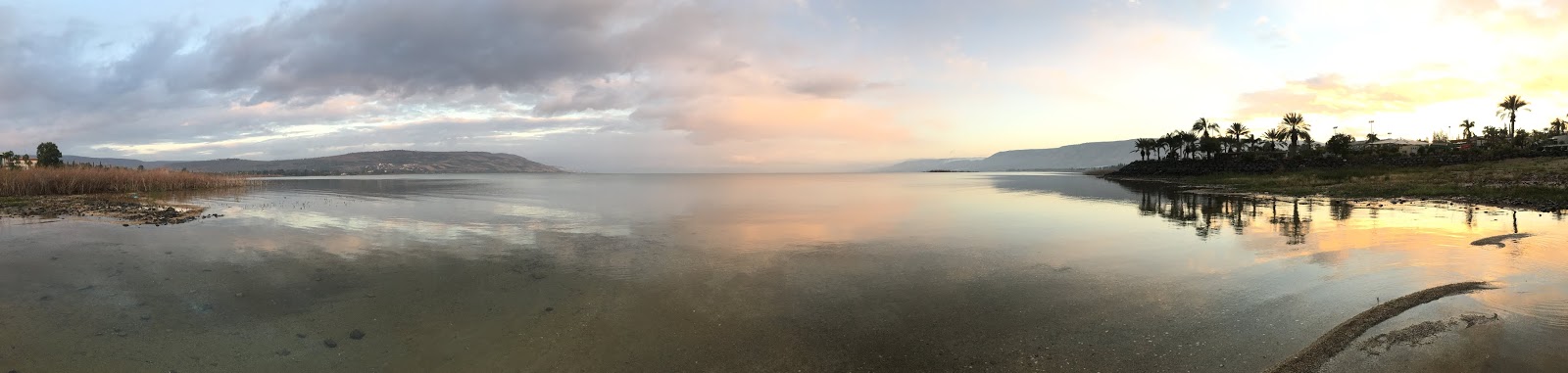
The sun is rising and I have my toes in the water of the Sea of Galilee, where Jesus walked on water, where several of the disciples worked as fishermen, and where a number of towns and churches were established. My first reaction is that it was damn tiny. We were in an inlet so not exposed to the entire 13 by 7 mile long expanse. But dawn breaking over a body of water that you've heard in stories your whole life, was fascinating. It wasn't a homecoming, but it was a surreal experience to try to marry decades of mental images from stories to the reality of the cold water washing over my feet.


But here I was, toes in the water, watching dawn break, wondering how many thousands of people had done this very same thing over thousands of years in this spot.

Wide street in Safed

While it was (seasonally) raining we started at Safed, an ancient city (do I need to continue to use that word?) and one of Judaism's holiest. It was small, winding, with slick stones.

Synagogue in Safed

We started the visit with a trip to a synagogue , an explanation of the difference between it and a temple, as well as some background on Judaism including the rules. It was fascinatingly engaging and, after several questions, we were set loose to explore the city in the rain.


The city has an enormous arts community with the fairly common (paintings) and the pretty wild, like a wax/candle shop that makes amazing sculptures. I had a lemonade prepared in front of me by the person reaching out the glass-less window next to him and plucking a fat lemon directly off the tree. Mixed with water and sugar stripped directly from a piece of sugar cane I couldn't say it was the best I've ever had, but it was certainly the freshest.There were art galleries, shops, and museums to visit and we walked through them all.


Next we drove up the Golan Heights and the weather went from a bit chill, to cold, to wow that's deep freeze January weather!

On the way up the mountain we saw large fenced off fields still marked with land mine warnings. Left overs from the war.


We were promised a view of Syria from the top, a former military camp and emplacement, but the weather denied us due to the cold and we were well settled in a cloud bank and could hardly see 10 feet in front of us. But we did get to crawl through trenches and emplacements, enjoy the minimal gift shop and look at photos of what we might have seen had we not been sitting in a cloud.

We THEN (no the day was not over) went for lunch at a kibbutz.  It felt a lot like an American summer camp with bunk houses, activities, and groups moving around.An emerging issue with Kibbutz's in Israel is that they are shrinking in size and no longer able to maintain as family enterprises, having to rely more and more on hired help. Tthese group/family owned joint ventures are worth millions in profits a year but traditionally did not allow new members to join. So as the owners age out, they have come to find that the younger family members left because they were not allowed to join and there's no one to take over.

This is compounded by the fact that they moved from farming to industry and are no longer the innocent small communities they once were.


Following the lunch, we then traveled South to a winery which is a winery. It was nice, but I'm not much of one for wine, so it was basically a liquor tour with a sample at the end.

We returned to the Sea of Galilee for dinner and sleep to prepare for a full day including our first day in Jerusalem.


Sunday, May 12, 2019

Israel, Day 2: It's not a sunshiny day

Tel Aviv is a modern international city on the sea. In a country the size of the State of New Jersey, it serves as the flagship of  Israel and all that is possible. Tel Aviv's promise and energy shows in the shops, the restaurants, the civic structures, and the historic artifacts that abound in the clean, safe, and constantly under development city. And it's beaches. Which we drove quickly by in the rain.


We began the tour in the morning with the Port of Jaffa and an Statue of Faith on a hill in the small town lying at the edge of Tel Aviv. The whole area reeks of permanence and history that you find in few places around the world. Particularly in the United States.


But the legends of Jaffa are far older than Israel itself. The stones of the harbor are said to be the bones of the Kraken turned to stone by the head of Medusa held aloft by Perseus. This is the harbor Jonah sailed from before finding himself as whale chow. The port is more than 4,000 years old.

Jaffa and Tel Aviv, weather removed for convenience.


It is impossible not to be aware that you are standing on a paving stone on a street that may have been here at the same time they were completing the Great Pyramid in Egypt. That pretty much sums Israel up - no matter where you stand, sit, or lie, there are thousands of years of recorded history that involve the small piece of ground where you stand.


Simon the Tanner owned the home behind this door. He hosted Peter the Apostle, who raised Tabitha from the dead and received a vision saying it was okay to eat animals traditionally unclean in Jewish tradition. This is it. The birthplace of BACON.

Well, he interpreted it to mean he could teach Christian doctrine to non-Jews. So this is also where the world-wide Christian religion began.
But also, BACON.


The area around Jaff was originally undeveloped land and swamp. This worthless land was purchased by the emigrating Jews  and developed into neighborhoods. We toured the buildings, heard the history, and learned the origins of Tel Aviv and some of the modern nation of Israel.

Orange trees bearing the famous Jaffa Oranges. In February!

Lunch back in Tel Aviv and then we hit the road for Caesarea - our first architectural miracle built by Herod the Great. It has an intact ampitheatre,


a hippodrome,


and artifacts you can watch as the sea slowly takes them.


There's also a gift shop - but this seems kind of half hearted, with a few snacks, some religious material, and t-shirts. It was the first time I've ever experienced a kind-of "myeh" approach to tourism. It wasn't bad, but...is it sad I have high expectations for trinket presentation?

The ruins are old and, if you have any knowledge of Roman history or architecture, fascinating in that they were not built by Romans but to impress Romans. Herod basically out-Romaned the Romans in some respects.

There are even two still standing aquaducts along the beach that can be climbed up and walked, but the are full of sand and trash. Still, it's amazing to stare down the line into the distance and try to imagine the scope of construction without modern equipment.


As the sun set, we boarded our bus to travel to Tiberius, the Sea of Galilee, and Kibbutz Maagan Holiday Village.


Friday, May 10, 2019

Israel, a pilgrimage to see what the fuss is all about...

Never, ever, ever fly into Istanbul Airport.

If you have to fly TO Istanbul, fine. But if you're catching a connecting flight...good luck.

I arrived at 5 am from New Jersey, deplaned on the tarmac, bussed to the terminal. And was told that I would not know what gate my flight was at for Tel Aviv until 30 minutes before it departed.

I was then given the wrong gate three times and barely made it to the plane 5 minutes before departure. God forbid I would have carry-ons, children, or not been able to run a mile in 6.5 minutes. Because everything would have been left behind. And from the number of parentless children wandering the airport, it was clear I wouldn't have been the first to make that decision.

Otherwise I might still be sitting in Istanbul to this day, just missing each new flight as I chased boarding gates around, never quite reaching one.

But make it I did and several hours later, landed in Tel Aviv, made it through customs, and found the guide for the tour group for Israel.

Our guide, Guy, gathered us up as we came in drips and drabs by the luggage carousel. This was my first tour group and I was staying quiet and to myself. I had been warned that tour groups to the Holy Land could attract odd ones and, quite frankly, I was not there for personal reasons including quiet reflection and to explore the roots of my faith. The rest of the group seemed as quiet and to themselves and quickly it became apparent that this would not be a drinking and carousing crowd.

Once gathered and bags collected, we headed out to the tour bus, stored our bags, and then headed into Tel Aviv to the Hotel Cinema. A reception area with light refreshments awaited us while we were given packets to our assigned rooms. I  paid the additional fee for a single rather than take on a roommate. Quiet and solitude was seriously what I was seeking.

With my L'il Deadpool of course
As noted, this was my first tour group. Normally I travel alone, so was not used to having to do the whole "group" thing which included a meeting where we were given our itinerary, some basic rules (stay with the group, don't wander off) and a headset that Guy our Guide could broadcast through over the next week or so. THis was nice, since pretty much no matter how far I wandered off, I would be comforted by his dulcet tones in my ear explaining whatever he was directing the group toward.

The question came up, of course, with regard to our safety. Guy handled the question with grace, explained that we would be fine. He was not dismissive of the concern, but it was clear he was used to getting questions about violence, kidnappings, and the like. On the other hand, the history of violence couldn't be ignored, especially given the double vault doors to our rooms.


The rooms, the staff, and the dinner were quite good. The balcony view of the city with musicians and drinks, unfortunately, reminded me that I had not slept in nearly 24 hours (no I don't sleep on planes) and after a quick walk through the neighborhood for orientation, I immediately crashed.

My view from the room before passing out.


Tuesday, May 7, 2019

Now's the time...to say goodbye...Chine Day 9

Today is Saturday and a cultural visit day.  The business visits are behind us, but the lessons learned continue to resonate as we move through the city of Shanghai.

On this next to last day we were faced with a prime example of the disparity found in China.  We visited the area of construction for what will be the second tallest building in the world.  It sits in an area that was once rice paddies and is now a fully developed modern economic center.  And this was completed, infrastructure and all, in just 7 years. A shining marvel and achievement to all that Chins is capable. The country and culture that built the Great Wall and The Forbidden City and Tiananmen Square.

We then visited the Jade Buddha Temple, a direct connection to China's past, surrounded by the impoverished begging for change.  These two sites sit in the same city, on opposite banks of the river, but are an excellent symbol of what China was, is, and could become.  China has the potential to, literally, move mountains to create cities, but it has to develop a way to encourage the population to become independent and self-motivated.

A huge population that awaits instruction for the next project is just a tool and cannot yield the rewards that a large population of motivated entrepreneurs with the resources of the country behind them.

Shanghai Tower under construction
Shanghai Tower

We ascended in the third tallest building in Shanghai, to the left of the Shanghai Tower in the above photo.  Our view from the observation deck included both taller towers as well as an amazing view that entire east side of the river was rice paddies in 2005.  

An infrastructure was developed and built, then buildings, including housing and skyscrapers were constructed in a large area.


Jade Buddha Temple
Our trip to the Jade Buddha Temple was  irst time seeing things behind glass and removed from pubic.  First signs of poverty and begging we had seen.  We toured the working temple, enjoying the stories and artwork until we got to the final room containing the jade Buddha.


This is a working temple and with the traffic it is unfortunate that so many of the ancient screens and religious icons are being worn away as coins being jammed into crevices in the artwork will eventually wear it away until it is unrecognizable.

Silk Factory
This was one last chance to see a major Chinese industry...and buy something for a negotiated price of course.

Yuyuan Garden
In the center of Shanghai is a private home with beautiful gardens built in the 1500's.

Shopping
We finally ended up in a shopping district where we were able to purchase final gifts and spend the rest of our remaining Yuan as we could not trade it back in.

Dinner
At the end of the day a group of us wandered the city in search of Sushi. We located a high end restaurant with an all-you-can-eat and all-the-beer-you-could-drink for a phenomenal last dinner.

Tuesday, April 30, 2019

Day 8: Time to get serious

It’s Friday and we have the last three remaining businesses to visit.  We are all looking to the end of the trip, especially since this marks our first night to head out to enjoy Shanghai nightlife.  And Saturday promises to be another day filled with cultural visits and more nightlife.

And we have a number of people who have been in Shanghai before and are promising that it will be memorable. I'm just hoping that doesn't mean arrested like it usually does.

Unfortunately, because it is a full day of business visits, it didn't make for great photographs...

Bó Lè  Associates (Executive Search)

"Bó Lè Associates is inspired from a famous proverb in the Tang Dynasty about "Bó Lè" (伯乐). Bó Lè was known as the caretaker of heavenly steeds, and his skill at judging horses was exceptional. He was able to select horses that could run one thousand miles a day - that is, horses of exceptional strength and stamina - from among herds of even the best horses.

Bó Lè is renowned in legend for spotting an old horse dragging a cart of salt. He purchased the seemingly bedraggled beast and, after a period of careful nurturing, proved that it was indeed a "thousand mile horse".

 Americans are seen as good balance between European managers (too strict) and Chinese (not experienced enough).  Without the balance that American management brings to business there is a concern that the Europeans and Chinese are too far apart.  

(our group was tasked with Henkel and below is the history section of the company, which is quite interesting.)

Henkel history and background
Henkel is an international company established in Germany in 1876 with three main product lines: Home Care (including washing soaps and powders, etc.), Personal Care (make up), and Adhesives, Sealants, and Surface Treatments for personal and industrial use.  The company is broken into four business sectors to oversee these areas, Laundry and Home Care, Cosmetics/Toiletries, Consumer and Craftsman Adhesives, and Henkel Technologies, the research and development wing of the company.

Origin of the Company
Fritz Henkel founded Henkel & Cie in Aachen, Germany in 1876 to manufacture washing detergent.  The used sodium silicate or "water glass".  It was used as a soap substitute during the American Civil War and gave Henkel and his partner the idea for using it as a base for laundry detergent.  Water glass is a mixture of sand, soda and coal.  In 1886 the company established its own water glass manufacturing plant opened the first foreign office in Vienna.  and salesmen are also selling several products in addition to the washing powder, including a pomade, starch and a bluing agent for washing.

13 years later, in 1898 the company registered for its first patent for "readily soluble" water glass, establishing a tradition of research and development in the company.  The company would go on to create an R&D lab in 1905.  The next year, 23 years after the company was founded, a rail line was built to serve the new factory that consisted of a bleaching soda factory, water glass factory, boiler house and workshops and an office building.  The company now employed 79 people at three manufacturing plants that made: Henkel's Bliech-Soda, Martellin fertilizer, Henkel's Three, and water glass.  The first three are for public consumers and the fourth is for purchase by other manufacturers.

1905 saw the establishment of a chemical lab for research.  In 1907 a new product was developed that combined Hydrogen Peroxide with water glass to create Persil.  This new product cleaned clothing "automatically" and there was no need to scrub clothing by hand.  This meant no additional wear and tear on fabric and freed up time and energy normally put into washing.  This was the first such product introduced in the world.

Because of the popularity of the product traveling sales staff took a back seat to promotion.  The company became a leader in advertising with the benefits of the new product as primary and the intended purpose secondary.  Henkel led the way by developing many advertising techniques still in use today.  Full page advertisements were taken out in newspapers, and men were hired to dress in white and carry Persil parasols through busy shopping streets.  The advertising budget ran to nearly 1 million marks and the product was sold throughout Europe and England.  Persil reached across the Atlantic to the United States in 1910. 

Development of Adhesives Business
On January 11, 1923, troops from France and Belgium occupied the Rhineland. The occupation made delivery of adhesives from suppliers used for the packaging of Persil unreliable. As a result Henkel started to manufacture adhesives internally for its own packaging needs.  Henkel found there was a demand for adhesives on the market, and on June 22, 1923, the first adhesive shipment left the plant.

Over the next several years, expansion efforts for the company were mainly creations or purchases of companies for products produced, or agreements or licenses to manufacture products in foreign countries.  In 1927, because of the similarity in products, Henkel and the Lever Group divided the world into "Persil interest zones."  Lever took England and France, along with their colonies, while Henkel took the United States, Canada, Korea and China.

Significant dates in the company's world-wide expansion include, 1951 when the company established P3 Products, Ltd. in Durban, South Africa.  This is the first Henkel subsidiary outside of Europe.  Its success led the company to continue expansion.

Entry into US Market
In 1960 Henkel acquired Standard Chemical Products, Inc. of Hoboken, NJ and Charlotte, NC and entered the US chemical products market.  This was changed to Henkel, Inc. in 1971 and the company was moved to Teaneck, NJ.  That same year saw the creation of Henkel Chemicals, Ltd. in Hong Kong as a distribution company.  The company would continue to be a presence in the United States, purchasing Loctite in 1987 and The Dial Corporation in 2004.

Entry into Chinese Market
The company's international experience and success led to its first joint venture in China in 1990 in Shanghai.  The company, Shanghai Henkel Chemicals, Ltd. was located in Gu Lang Lu.  This led to a second company,

Guangzhou Henkel Chemical Products Co., Ltd. in 1991 and then Shanghai Henkel-Teroson Adhesives & Coatings Ltd., Shanghai.  Ultimately the companies fall under the Henkel (China) Investment Co, Ltd, established in Beijing in 1995 and moved to Shanghai in 2000.

 Henkel is dedicated to bringing high quality products to the Chinese market, creating jobs and opportunities for Chinese workers, and ensuring positive relations with consumers and the government.

Diagio is a liquor importer most well known for Johnnie Walker, Tanquery, Smirnoff and Guiness beer. The products that they carry are associated with Western culture and the company markets to both Chinese culture and the emerging wealthy market.  The company is also negotiating to market local Chinese alcohols such as Baijiu.

They had an open bar. Don't remember much after we stopped drinking to head out partying!

After returning to the hotel, we gathered up and headed out to the Bund and an English Pub filled with ex-pat's.  For the first time since arriving in China we had a western meal with cold beer.  After the meal we piled into taxis and headed to a club recommended by a local.

The bar was filled primarily with prostitutes and we were offered the opportunity to sit at a table with champagne service for 1,000 Yuan.  We finished our drinks, danced for a bit, then headed out back to the hotel where we continued to socialize in the rooftop bar.  Not quite the night life we were looking for so we resolved to plan better for our last night in Shanghai.

If you expected a prostitute story, wrong blog. 
Monday, December 17, 2018

China Day 7: Thanksgiving in a Foreign Land

 Today was a relaxed day with a traditional Peking Duck dinner for Thanksgiving and travel to Shanghai.  No business visits, no lectures, no discussions.

We sat in a gorgeous restaurant, surrounded by glitz and glitter, divided up into tables of 9 with the standard spinning center platter for family style service.  We were treated to a presentation of the Peking Duck traditional preparation which consists of, among other things, that the duck must be carved into 108 cuts exactly.

The number is sacred. The story was told. I was too preoccupied on what happens if you lose track of the count between 88 and 89.

This number matches the number of dishes served to the Empress Dowager Cixi, the last Empress of China, also known as The Dragon Lady at her meals.  The number 9 was prevalent throughout the day and was a constant reminder that numerology is very important to the Chinese culture and much of what they do operates around it.
There are worse ways to run a country.

As eldest at the table I was offered the bill, skull and webbed feet, all delicacies. This was done with some embarrasment, as they did not expect the American to actually consume them. I did. The feet are like gummy candies if you don't think too much about it. Beware the claws at the end. The skull was thin. I didn't eat it all, but they were delighted I tried.

We later boarded the train to head to Shanghai, saying goodbye to our local guide and heading out in a high speed.

If Beijing is equivalent to Washington, D.C. and Jinan is equivalent to St. Louis or San Antonio, then Shanghai is New York.  It is lit up in neon, showing constant signs of growth both as a financial and business power, and full of highly educated and dynamic people busily going about their days.  Their evenings are as energetic, with clubs, bars, and restaurants packed with people dressed well, arriving in expensive cars, and spending fistfuls of money.

We were excited at this point for the final leg of our trip.  We were seeing one  of the most famous cities in the world, were going to be seeing several very exciting businesses, and we would finally have a chance to go out and experience night life that was familiar.

Oddly, we were wrong about the third...

Thursday, September 20, 2018

China Day 6: Ironic contradictions of an intellectual nature

This was the morning that I realized that there was no internet connection back to the United States.

Yes, it took 5 days.

Or anywhere else outside of China. I could not update Facebook, access Google, or even get to my personal website to check email.  It was an odd feeling to be in a country with such advanced technology but to feel so isolated.

I was able to use Skype for phone calls so all was not lost.

Today we started our visit with Sinotruck who, ironically,  asked that we not to take any photos on the production floor or premises. A country notorious for stealing intellectual property was suddenly conscious of the issue and looking to protect it's secrets.

The company manufactures light and heavy duty trucks used all over the world.  We toured the assembly line and were shocked to see no evidence of safety equipment.  No gloves, no ear protection, no eye protection, no anything as workers nimbly danced in and out of chassis moving down the line, assembling this or placing that.  The floor, areas, even rafters were clean, no sign of grease, chemical spill or blood anywhere in sight.

There were painted lines, rights of way, signage, and other protection in the areas.  I don't want to make it sound stunningly dangerous, we were limited to an overhead catwalk to keep us off the floor and out of the way and I didn't see any sign of injury or issue.  In addition, we were shown the training area for workers.  Individuals can sign up and receive cross training in other areas to support the company if someone is ill or unable to work, or to be promoted to a new area or job.

Next we toured Sang Le Solar a company that builds and sells solar powered water heaters for installation on building roofs.  This is a highly efficient system and provides (mostly) hot water for bathing and sinks in apartments and smaller homes. Parts for the water heaters are made by another Chinese company including the key component, the tubes that make the system operate efficiently.

There was an explanation for the importance of the tubes, demonstrations, and even visuals but since I don't have an engineering degree I relied on the nods and approving looks of the engineers with the group.  The company is fortunate to have a government contract and the units are ordered and installed on government owned apartment buildings. This means guaranteed sales and maintenance contracts for the company. This is in direct contrast to the water bottling company we visited yesterday. There was not an apparent lack of pride in the work of Sang Le, but it was definitely not as enthusiastic.

We attended a reception at  Shandong University, and their business students. Remarks were made, gifts exchanged and we were broken into groups to meet and talk about business in China and the United States.

Conversation was a bit stilted at first.  It was explained that Chinese students are educated in a very traditional form, with students taking notes or listening to a teacher without asking questions or requesting clarification until after the class is over.  This makes for limited English speaking, but their written English was better than most native speakers I know.  So if there was a breakdown in communication, all that was required was a pen and paper to get things going again.

To a person they were all college graduates who could not find jobs in their field of study.  The jobs they had were working on factory lines, in department stores as cashiers, or other places where they could find work.  They had returned to graduate school, passing very competitive examinations, in the hope that they would be eligible for jobs at higher salaries with less manual labor and able to work in professional areas in which they were interested.

After pleasantries and introductions, the first conversations began in our groups.  The focus turned to oil and seeking new markets for materials made with crude, such as plastics and clothing.

The second conversation was on elder care and medical care for the Chinese.  Both conversations were fascinating if for no other reason than just to hear someone speak to familiar issues from a different culture.

We ended the evening in a traditional Karaoke bar.  While there are photos of that, I'm not sharing them.  Some things just have to stay in China...

Monday, September 17, 2018

Slide for your life down 1,000 Buddha Mountain!

We awoke to another clear day in China.  Both our tour guides and the group continued to profess their amazement at the weather.

We had been warned that Jinan was a second tier city (only 7 million people) and was not used to seeing whites or Americans so we should be prepared for more attention. However, on arriving at breakfast at hotel we noticed that the room was filled with American's.  Sitting down to tables with them we discovered that they were part of a large adoption group there to finalize procedures  and take children back to the United States.

Suddenly we were not so special.

We did head to a market on our way to our first location, a cultural visit to 1,000 Buddha Mountain.  We bought fresh fruit and our country guide Frank handed me a Mandarin Orange.  I started to peel it and he grabbed my hand.  "What are you doing?  The skin is the best part?"  He popped one whole into his mouth and began chewing.  Having eaten a number of strange things so far (including fried scorpion) I followed suit.  It was actually better than peeling, with the tart rind balancing the sweet orange.  


1,000 Buddha Mountain is an artificial cave where hundreds of Buddha statues of varying size and type are carved, stored, displayed and, in some cases, dumped.  The cave could not hold all the Buddha's and they spilled out over the mountain, finally ending in a giant laughing buddha nearly 100 feet tall, looking to be made of gold.

We walked up the mountain past giant Buddhas in various poses with prayer strips and people burning incense. Because it is an active religious site, nothing is gated, fenced or otherwise restricted. Something fairly common in China. Respect is expected and adhered to.

Once inside the cave itself the Buddha's, and other antiquities, were open to the weather and people to touch and handle, (and hopefully not damage), at will.  Only a handful were behind locked doors or glass.   It seemed that it was just good will and respect for the Buddha's that kept them safe.  But environment and weather are clearly working away at them.

As we progressed through the cave, a guide explained that bribery is rampant and even Buddhists are not above it. This came up from a question - someone int eh group observed a monk driving into the parking lot below in a brand new Mercedes Benz.

We ended the self-guided tour at the back with a donation and our names entered into a prayer book, then exited to tiredly look down the mountain and the climb down. Our guide ushered us off to the side and into a lock and gate system similar to an amusement park.

Because that's what it was - a ride.

The visit ends with an Alpine Slide down 1,000 Buddha mountain.  It had pangs of Disney - and since we were flying by below the belly of a giant laughing Buddha, didn't feel particularly disrespectful.

We left and drove through streets and neighborhoods of Jinan, stopping for a traditional Chinese family lunch at a lovely restaurant clearly popular with locals, before heading to Pease Water Company.

This is a privately owned Chinese bottled water company set up over natural springs in Jinan.  The owners and workers of Pease take great pride in the fact that they are independently (not government) owned and their success is due to hard work and entrepreneurial spirit as opposed to guaranteed government contracts. That pride came through in the very gracious reception, the tour the bottling plant demonstrating the cleanliness and use of innovative technology, to the storeroom floor and the stacks on stacks of bottles ready to ship.

They presentation of the company was fairly short, but touched on the challenges that they faced as a privately held concern in a formerly communist country.

We ended the day in the best way possible, with a visit to Tsingtao brewery. Any day that ends with a brewery tour. There was no reception, but there was a tour of the museum and history of the beer in China, a walk through an educational section designed to replicate being drunk without consuming alcohol to remind people not to drink and drive, and then on to a reception with freshly brewed beer, snacks and small gifts.

Thankfully we had a bus to get us back to the hotel, where we mostly passed out from the exercise and alcohol. 

Thursday, September 13, 2018

Doing Business in China - it's easier/far harder than you think...

It's Monday.  The weekend is over and it is time for us to get down to the business of our trip - visiting companies and discussing emerging markets, specifically in China.

This will also be our last day in Beijing before we head to Jinan in the Shandong province. So it's a sad, but exciting, day.

We start the day with a briefing at the US Embassy.  The impressive part of the discussion was the candor and direct responses to our questions.  The unfortunate part is that, as informative as it was, a lot of it was confidential and cannot be discussed.  However, the information was not original and did not color our views of either the country or the trip, but merely served as an explanation for a lot of what we saw and answered questions we had on issues with starting and maintaining foreign businesses within China.

One of the issues brought up, for instance, is the reliability of food quality in China.  Consistent quality of food, transport, sale and pirated packaging is a universal concern not just for local markets and "street meat" but has shown up overseas in baby food and animal food.  This is a recognized issue and the country is attempting to respond to ensure consistent quality.

Lawsuits and bad press have a way of getting someone's attention.

Our first business visit (aside from the Jade store) is with General Electric Medical devices.

We were received by several executives in a meeting room, provided refreshments and a generous welcome.  We were then treated to a slideshow presentation that gave not just an overview to GE's development in China, but in general development in the country.

With over 1.5 billion consumers it is understandable why companies want to develop business in China, with such an enormous market it is critical to first identify what type of business you want to do there.  GE is developing In China for China (ICFC) products which means that they do not create products for export, but for use within China.  In the medical device market there are urban global players such as hospitals, and there are rural local players.  To reach the suburban markets GE, with their ICFC strategy, set up salespeople in second and third tier cities to learn the culture and market as a holistic enterprise. 

 This is important as each region within China has challenges that need to be mastered.  Ensuring that they understand how each region operates and what positions them best in that region is a critical goal for companies like GE who recognize that China will eventually become their biggest markets.
Because of the issues with Intellectual Property protection there is a risk of localization in China with any product, but high tech products are particularly susceptible.  Companies like GE keep critical parts of their devices separate and key items in a secure location.  Final assembly is done in a different location to avoid intellectual property theft.

 This issues mean that companies may only decide to bring 10 year old technology to China while leaving newer products back in the United States or Europe where they enjoy IP protection.

Because of the recurring IP issues GE is focused on commitment to a high quality product and support to their customers.  This also helps compete against less expensive knock offs since they are not as high quality and their support is not as sophisticated as GE's.

Our second visit is with Ogilvy & Mather Advertising.

The owner of the company has a simple philosophy: The consumer is not a moron, she is your wife.

The company deals with public relations and advertising for companies.  One of the company's areas of expertise is foreign clients who are doing campaigns in English.  This requires that their specialists be versed in two cultures and able to operate, and translate, from one to the other and back.  For instance, one of their specialties is training clients to talk to the media succinctly.  This requires an executive to sometimes have to prepare and deliver remarks in a language that is not native or to a culture where gestures or facial expressions may carry a different message.

One of the most interesting parts of the presentation was the method of direct advertising used in China.  They do not use flyers or direct mail, but send messages, coupons and other advertisement directly to cell phones.  This guarantees that the people on the receiving end have disposable income for the products or services advertised.

But in China it is not just about reaching the consumer.  Reputation is critical and Ogilvy has developed a method of measuring reputation through four emotional indicators: Trust, Esteem, Admiration and Good Feeling. It is part of the complete package that the company offers to clients to ensure that the campaigns and products are positioned appropriately in foreign markets.

Train ride to Jinan:
We boarded a high speed train to Jinan after the visit with Ogilvy, enjoying first class service on the train ride.  We met with our local guide at the station in Jinan.  She greeted us with some stories about local culture, sang a traditional song, then got us to the hotel.  Unfortunately for her, we had been drinking for several hours and a few of the members then treated her to some traditional American music in the form of Beastie Boys.

After checking into the hotel we piled into cabs to continue enjoying finally getting over jet lag and feeling like normal at 9 pm.  The bar had a local musician, beer and smoking allowed.  You really forget what its like to reek of cigarette smoke after an evening out.  Being reminded was one of the less pleasant parts of the trip.